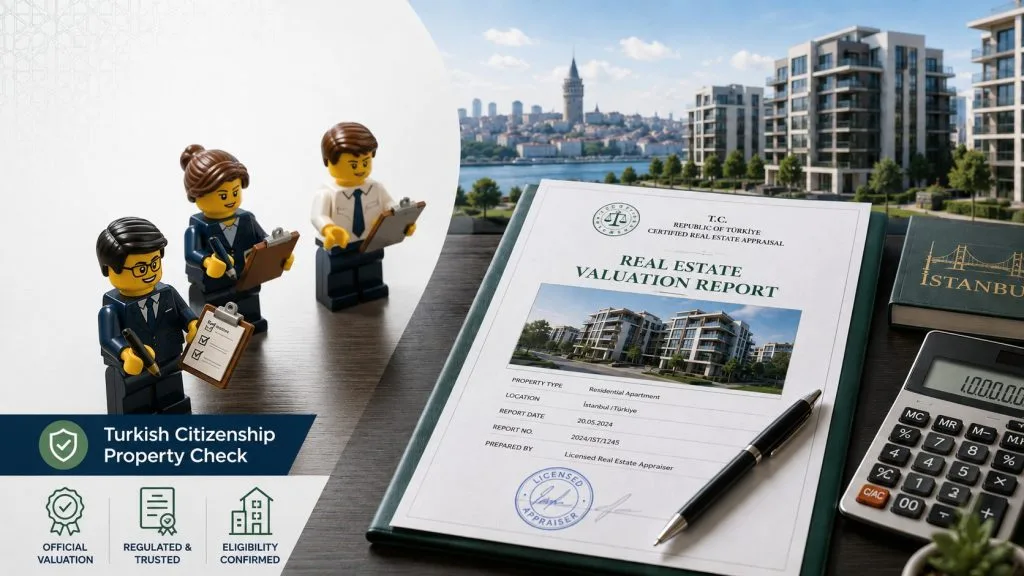
The valuation report is one of the biggest risk points in a Turkish citizenship property purchase. A property may be advertised above USD 400,000, but that does not automatically mean it will qualify for Turkish citizenship by investment. The official valuation, title deed status, payment records, DAB documentation and conformity review all need to support the application.
This guide explains how the Turkish citizenship valuation report affects property buyers, why asking price and official value can be different, and what foreign investors should check before transferring funds.
Turkish citizenship guide series
Before you continue
If you are still reviewing the wider process, start with our main guide to Turkish Citizenship by Investment. You can also continue with the related guides below.
What is a Turkish property valuation report?
A Turkish property valuation report is an official appraisal which is prepared by the Turkish government body, GEDAŞ. It’s obvious use is to assess the value of a property, and in the case of citizenship valuations, its only function is to confirm that the property in question is worth at least $400,000. In the past, the report would use property agent guided comparable properties for valuation estimation. Nowadays that function has been removed. It is the seller that must apply for the report, but it is usually the buyer who pays for it. At the time of writing, the cost is 55,000 lira (about $1,800).
For normal buyers, valuation may feel like a technical step in the transaction. For citizenship buyers, it is much more important. If the valuation does not support the required investment level, the property will create problems for the buyer even if the transaction exceeds $400,000.
This is why buyers should not treat the developer price, asking price or sales brochure as enough evidence. The valuation needs to be checked as part of the citizenship file. This should be done PRIOR to making any payment to the seller!
Why valuation matters for Turkish citizenship
The Turkish citizenship by investment property route is based on a qualifying real estate investment. The transaction therefore needs to show that the property value, payment records and title deed process support the citizenship application.
- The official valuation helps support the required investment threshold
- It reduces the risk of relying only on seller or developer pricing
- It helps the lawyer assess whether the property is suitable for citizenship
- It is required by the land registry when transferring the title deed – for all foreign transactions, not just citizenship files.
- It helps buyers avoid weak or overpriced citizenship stock
Asking price, sale price, valuation and title deed value
Buyers often assume that the asking price is the same as the official value. In practice, several different figures may appear during a property transaction, however for citizenship, all values must match. The sale price can be agreed in USD/EUR/GBP, however when it comes to the title deed, the declared value must match the amount displayed on the DAB document.
| Figure | What it means | Why it matters |
|---|---|---|
| Asking price | The price advertised by the seller, developer or agent. | Useful for negotiation, but not enough by itself for citizenship eligibility. |
| Sale price | The price agreed between buyer and seller. | Should align with the payment trail and legal transaction documents. |
| Official valuation | The assessed value in the valuation report. A value is no longer provided by the authorities. Just a qualifies or does not qualify statement. | A key document for checking whether the property supports the citizenship threshold. |
| Title deed value | The value recorded in the title deed transfer process. | Must match the DAB certificate. |
| Payment records | Bank receipts, DAB and related payment documents. | Help show how the buyer paid and how funds moved through the banking system. |
These figures should be reviewed together. A high asking price does not solve a weak valuation. A strong valuation does not solve unclear payment documentation. The file needs to make sense as a whole.
What happens if the valuation is below USD 400,000?
The report produced by GEDAŞ now simply states “qualifies for Turkish citizenship” or “does not qualify for Turkish citizenship”. If the official valuation does not support the required investment threshold, the property IS NOT SUITABLE for the real estate citizenship route and the buyer should pull out of the transaction. This is why its crucial that a CBI investor asks for the GEDAŞ report BEFORE making any payment. All property that is purchased with Pera Property is thoroughly checked by our experienced directors first and then signed off by our laywers.
Depending on the stage of the transaction, possible options may include choosing a different property, renegotiating, adding another eligible property, or restructuring the purchase with legal advice. Buyers should not try to solve a valuation problem informally or after the payment trail has already been completed.
Practical point: citizenship buyers should avoid borderline properties where the asking price is only slightly above the threshold and the valuation position has not been checked. A comfortable valuation margin can reduce risk.
Red flags before paying for a citizenship property
The valuation report should be part of the buyer’s pre-payment risk check. If any of the following issues appear, the buyer should pause and request legal and valuation guidance before committing funds.
- The seller says citizenship is guaranteed without valuation review
- The property is priced just above USD 400,000 with no valuation confidence, especially resale property
- A large part of the price is allocated to furniture or non-property items (like cashback schemes which are illegal)
- The developer pushes for urgent payment before documentation is ready
- The seller cannot clearly explain title deed or payment structure
- The location has weak resale demand after the three-year holding period
How valuation connects with DAB and payment records
The valuation report supports the property value. DAB and bank receipts support the payment and foreign currency documentation. These are separate parts of the transaction, but they need to work together.
A buyer can have a proper DAB process but still face a problem if the valuation is declared as “not eligible” by the GEDAŞ valuatıon report. A buyer can also have a strong valuation but weaken the file with unclear payment records or DAB documents with even simple/innocent spelling mistakes. This is why citizenship property purchases should be planned as a coordinated process rather than separate steps.
For more detail on payment documentation, read our guide to
DAB in Turkish Citizenship Property Purchases Explained.
How valuation connects with the title deed process
The title deed, or tapu, proves ownership of the property. In a citizenship-linked purchase, the title deed process is also connected to the three-year no-sale commitment. The valuation report does not replace the title deed, and the title deed does not replace the valuation report.
The citizenship file should show a coherent transaction: the buyer purchases the property, the payment is properly documented, the title deed is transferred, the holding restriction is recorded, and the investment can then be reviewed for conformity by the registry.
For a wider explanation of ownership transfer, see our guide to the Title Deed (Tapu) Process in Turkey.
Valuation and multiple-property citizenship applications
If a buyer uses more than one property to reach the citizenship threshold, valuation becomes even more important. Each property may need its own valuation and documentation, and the combined qualifying value must support the required investment amount.
Multiple-property strategies can work well for some buyers, but they are not automatically simpler. Timing, title deed transfer, payment records, DAB documentation and valuation reports all need to be coordinated carefully.
| Strategy | Potential benefit | Valuation risk |
|---|---|---|
| One property | Cleaner documentation and simpler ownership structure. | The single property must comfortably support the required value. |
| Multiple properties | Can diversify across units, locations or rental profiles. | Each property needs valuation, title deed and payment consistency. |
| Off-plan property | May offer newer stock or staged payment structures. | Project documentation, title status and valuation timing need legal review. |
| Resale property | Can offer stronger location and liquidity if selected well. | Seller history, title deed and realistic market value must be checked. |
How Pera Property approaches valuation risk
Pera Property helps buyers compare citizenship-eligible Istanbul real estate with valuation, location and resale logic in mind. The aim is not just to find a property that reaches the minimum threshold, but to identify a property that can stand up to legal, valuation and investment review.
- We focus on citizenship-eligible properties with stronger valuation confidence
- We avoid weak or overpriced stock where resale prospects are poor
- We coordinate title deed, valuation and eligibility checks with licensed Turkish legal partners
- We help buyers compare one-property and multiple-property strategies
- We consider district quality, liquidity and post-holding-period resale potential
- We want property in regions not just with good rental return, but high quality tenants
Talk to us about the Turkish CBI Program?
As one of Istanbul’s oldest property consultants, we have completed hundreds of CBI application with our clients. Contact us to get expert advice.
Professional guidance: Pera Property specialises in Turkish Citizenship by Investment and advises clients throughout the entire property acquisition process, from selecting eligible real estate to structuring the transaction correctly. The formal citizenship application is submitted by our licensed Turkish legal partners, who handle the legal filings while we coordinate the property and investment aspects of the process.