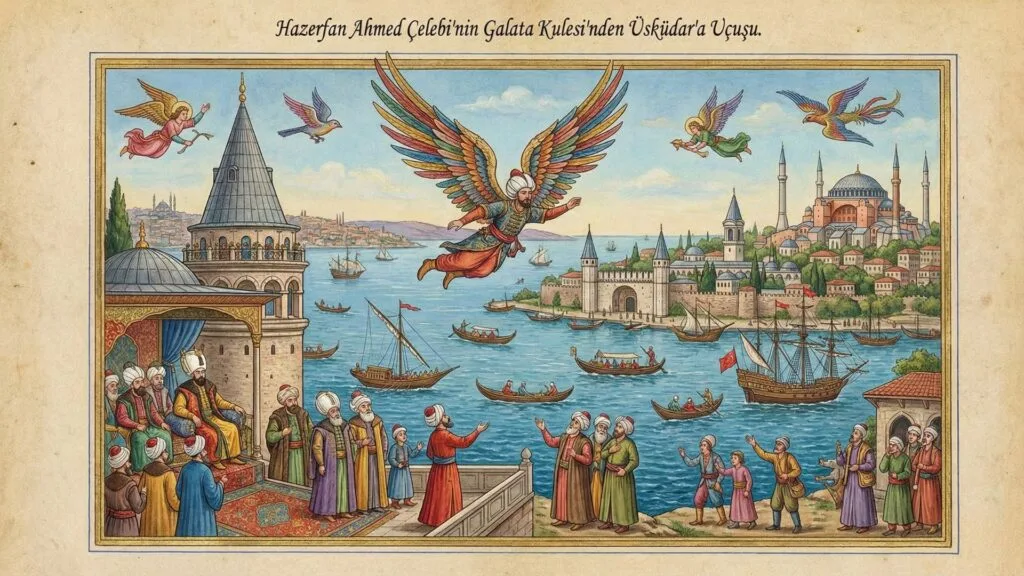
Long before modern aviation, Istanbul was home to one of history’s most fascinating flight stories. According to Ottoman records, Hezarfen Ahmed Çelebi may have been one of the first people to achieve sustained human flight.
While the Wright brothers are widely recognised as pioneers of modern aviation, Turkish history tells an older story — one rooted in the skyline of Istanbul, the height of Galata Tower and the winds of the Bosphorus.

In this article
- Who Hezarfen Ahmed Çelebi was
- The story of his flight from Galata Tower
- Whether the flight may have been technically possible
- His legacy in Istanbul’s cultural history
Who was Hezarfen Ahmed Çelebi?
Hezarfen Ahmed Çelebi was an Ottoman scientist, inventor and aviator believed to have lived in Istanbul during the early 17th century. His name comes from a Persian expression meaning “a man of a thousand sciences”, reflecting his reputation as a polymath.
Much of what we know about him comes from the Ottoman traveller Evliya Çelebi, who recorded the story in his famous work, Seyahatname.
The flight from Galata Tower
According to historical accounts, Hezarfen studied the mechanics of flight by observing birds and experimenting with wing structures. After several smaller trials, he prepared for a much more ambitious attempt.
In around 1632, he climbed to the top of Galata Tower, one of Istanbul’s most iconic landmarks. In front of a gathered crowd — and reportedly Sultan Murad IV himself — he launched himself into the air using a wing-like apparatus.
He is said to have glided across the Bosphorus and landed in Üsküdar, covering a distance of more than three kilometres.
If true, this would make his flight one of the earliest controlled glides in history, centuries before modern aviation.
Was Hezarfen’s flight really possible?
There is ongoing debate about whether Hezarfen’s flight truly happened. Some historians consider the story exaggerated, while others believe it may have been possible using early glider principles.
From a modern perspective, Istanbul’s geography — particularly the height of Galata Tower and the wind currents over the Bosphorus — could have supported short-distance gliding under the right conditions.
Whether fact or legend, the story reflects the spirit of experimentation and ambition that has long defined Istanbul.
The reaction of Sultan Murad IV
According to the story, Sultan Murad IV initially rewarded Hezarfen with gold for his achievement. However, concerns about his abilities soon followed.
Fearing his potential influence, the Sultan reportedly ordered him to be exiled to Algeria, where he later died.
Hezarfen’s legacy in modern Istanbul
Today, Hezarfen Ahmed Çelebi remains a well-known figure in Turkish culture. His story is taught in schools, referenced in media and remembered as a symbol of innovation and ambition.
His name lives on through aviation references, cultural works and local landmarks, reinforcing his place in Istanbul’s historical imagination.

Istanbul: a city of history and opportunity
Stories like Hezarfen’s highlight what makes Istanbul unique: a city where history, culture, architecture and innovation intersect.
Today, areas around Beyoğlu, Galata and the Bosphorus remain among the most sought-after locations for both lifestyle buyers and property investors. Their combination of heritage, central location and limited supply continues to attract buyers from around the world.
Looking to invest in central Istanbul?
Explore property opportunities in historic districts such as Beyoğlu, Şişli and along the Bosphorus with Pera Property.