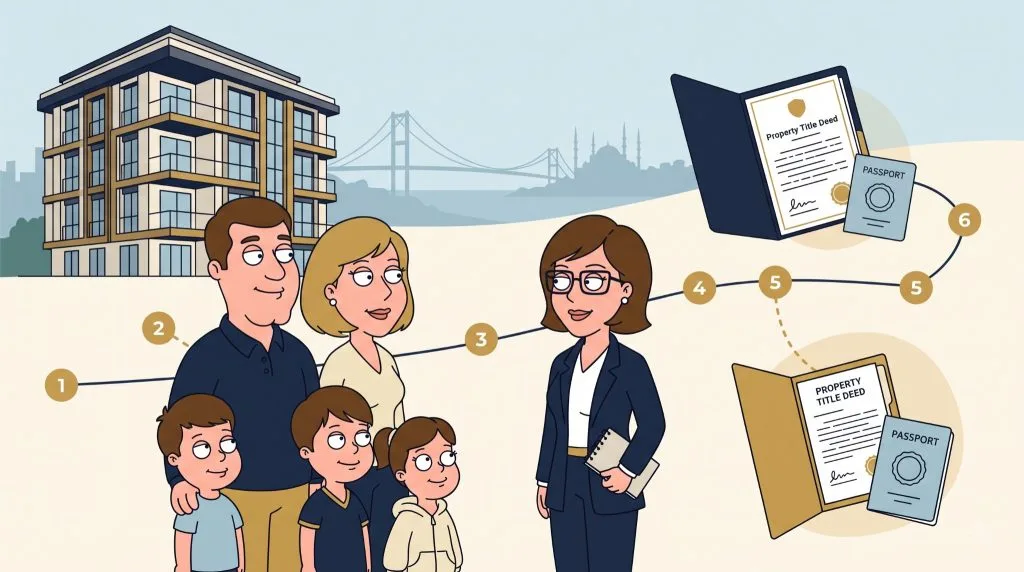
At a glance: the typical sequence
- Define the budget, investment objective and preferred areas.
- Shortlist properties and complete citizenship eligibility checks.
- Arrange the valuation, payment structure and required documentation.
- Transfer funds through the appropriate banking route and obtain the required currency-conversion documentation.
- Complete the title deed transfer and register the three-year sale restriction.
- Obtain the Certificate of Conformity.
- Apply for the investor residence permit and submit the citizenship application.
- Complete security and administrative processing, then receive the Turkish identity documents and passport.
Step 1: Define the investment brief
The legal threshold is only one part of the decision. Before viewing properties, establish the total budget, whether the purchase is primarily for residence, rental income, capital preservation or citizenship, and when the family expects to travel to Türkiye.
The current real-estate route generally requires a qualifying investment of at least US$400,000, subject to the programme’s applicable rules. However, a property advertised above that figure is not automatically a suitable citizenship investment. The recognised valuation, title deed position, seller history and payment records must all support the application.
Our guide to Turkish citizenship property requirements in 2026 explains the principal eligibility considerations in more detail.
At this stage, buyers should also separate two questions:
- Can this property qualify for the citizenship route?
- Is it a sensible property to own for at least three years and potentially sell afterwards?
Location, build quality, realistic pricing, rental demand and resale liquidity remain important even where the primary objective is a passport. This is where an experienced property consultant is worth its weight in gold. This additional information can only be obtained from an experienced and impartial property consultant.
Step 2: Shortlist properties and check them before reserving
Once suitable properties have been identified, the due-diligence work should start before a meaningful deposit is committed. This is particularly important for resale properties, but it also applies to developer stock.
The checks commonly include:
- Title deed and ownership information;
- Whether the seller and transaction structure are suitable for citizenship;
- Whether the property has previously been used for a citizenship application in a way that affects eligibility;
- Planning, occupancy and property-specific documentation where relevant;
- Whether the proposed price is likely to be supported by the official valuation; and
- Whether the payment route can be documented correctly.
A good citizenship property should not simply be selected because it clears the headline threshold. Buyers should be wary of inflated prices presented as a convenient “citizenship package,” particularly where there is weak local demand or limited evidence of comparable resale values.
Step 3: Prepare the documents, valuation and payment plan
Once the property is approved in principle, the parties prepare for the transaction. The exact requirements differ between buyers, but foreign purchasers will commonly need passport information, tax registration details (easily obtained online via the Turkish tax office website) and, a power of attorney. At this stage, the buyer should also have settled on their LAwyer for this process. As with the property consultant, a good lawyer is well worth their weight in gold. You should choose your lawyer based on their experience, especially if you have sensitive circumstances surrounding your existing citizenship.
An official valuation report is an important part of the citizenship property route. It is not just a formality: it helps demonstrate that the investment supports the required threshold. Read our detailed guide to the Turkish citizenship valuation report before agreeing the purchase structure.
The payment plan deserves the same level of attention. A seemingly minor mistake in how money moves from buyer to seller can create difficulties later. Buyers should ensure their lawyer and transaction team confirm the correct banking process before any substantial payment is made.
Step 4: Transfer funds and obtain the DAB documentation
Property payments need to be traceable. In a citizenship transaction, the authorities will review the relevant bank records alongside the title deed, valuation and other application documents.
Foreign-currency conversion documentation is also central to many transactions. The DAB — commonly referred to as the Foreign Currency Purchase Document — records the conversion process required for the purchase under the applicable rules.
It is essential to plan this process before transferring funds rather than attempting to reconstruct the paperwork after completion. Our article, DAB in Turkish Citizenship Property Purchases Explained, outlines why the document matters and the issues buyers should watch for.
The buyer should insist with the seller that the DAB is done within 24 hours, and absolute care must be taken when filling out the reference. The buyer must transfer with the correct refernce, which will include the apartment details. A simple mistake, a simple spelling mistake, can set you back months.
Step 5: Complete the title deed transfer and register the restriction
The property purchase is completed at the relevant Land Registry Office (Tapu Müdürlüğü), either by the buyer in person or through a properly appointed representative.
As part of the citizenship investment process, a restriction is recorded on the title deed confirming that the property will not be sold for at least three years ‘Şerh’. We usually recommend you keep it for five years for profit tax reasons Property Taxes in Turkiye.
Step 6: Apply for the Certificate of Conformity
After the purchase is complete and the relevant documents are assembled, the appropriate authority reviews the investment and may issue a Certificate of Conformity. This certificate confirms that the investment is considered to meet the relevant citizenship-by-investment requirements.
The certificate is a pivotal stage, but it should not be confused with the citizenship decision itself. There are still residence and nationality-application stages to complete afterwards.
For a fuller explanation, see Certificate of Conformity for Turkish Citizenship by Investment.
Step 7: Apply for the investor residence permit and citizenship
Once the investment stage has progressed appropriately, the principal investor applies for the residence permit associated with the citizenship process and then submits the nationality application. Eligible family members are usually included through the principal applicant, commonly a spouse and qualifying dependent children, subject to their individual circumstances and supporting documents.
At this point, document quality matters. Names, dates of birth, marital records and translations should be consistent across passports, civil-status records, powers of attorney and application forms. Where documents were issued abroad, legalisation or apostille requirements may apply.
The investment route does not generally require the applicant to live in Türkiye for a set period before applying. However, the residence-permit and citizenship filing process must still be completed correctly.
Step 8: Processing, approval and passport
Following submission, the file goes through administrative and security reviews. Applicants can monitor progress through their legal representative or there is now an online portal where you can see your application move through the various stages of checks.
When citizenship is approved, the family can proceed with Turkish identity cards and passport applications. The final practical timeline therefore includes not only the nationality decision, but also the time needed to obtain the identity and travel documents.
How long does the whole process take?
For a straightforward case, the property-search and purchase phase can be completed relatively quickly once a suitable property, documentation and payment plan are in place. The government-processing phase takes longer and varies from case to case.
As a planning guide, buyers should allow time for:
- Property selection and due diligence;
- Valuation and transaction preparation;
- Banking, DAB and title-deed completion;
- Certificate of Conformity processing;
- Residence-permit and citizenship filing; and
- Administrative and security review before the final decision.
Common causes of delay or risk
The most avoidable problems usually arise before the title deed transfer. Examples include paying a deposit before the property has been checked, using an unsuitable payment route, insufficient or inconsistent banking records, valuation concerns, or civil-status documents that need additional legalisation. You should pay particular attention to legalsing your documents especially if your situation is not straightforward.
The most reliable approach is to coordinate the property conslutant, independent legal adviser, bank and seller from the outset. Each party should understand that the transaction is intended for citizenship by investment and that the paperwork must support that purpose.
Choosing the right property team
The best time to assess citizenship eligibility is before the buyer becomes financially committed. Pera Property can help clients shortlist Istanbul properties that fit both the legal route and the commercial objective, while working alongside the client’s legal advisers on the required transaction sequence.
If you are considering Turkish citizenship through property investment, tell us your approximate budget, preferred Istanbul areas and planned purchase date. We can prepare a focused shortlist and explain the practical next steps before you commit.
Important: This article is general information only, not legal, tax or immigration advice. Rules and administrative practice can change, and buyers should obtain current advice from appropriately qualified professionals before transferring funds or signing binding documents.